



 by
by 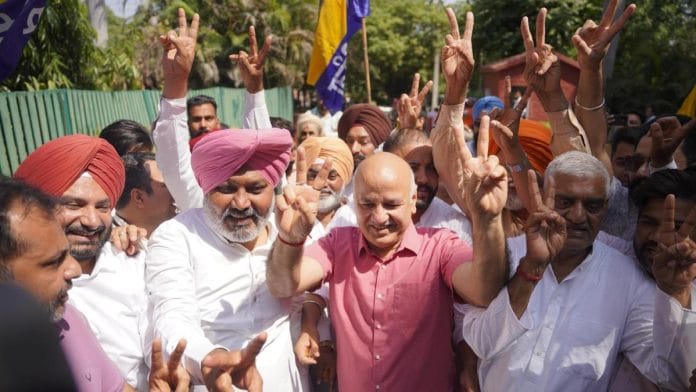
Punjab Municipal Elections: AAP Strengthens Its Position Amidst Opposition Struggles
In Punjab, over 22.38 lakh voters, nearly 64% of the electorate, participated in the recent municipal elections, which aimed to fill positions in 8 municipal corporations, 75 municipal councils, and 19 Nagar Panchayats. With 7,555 candidates vying for seats, this election was viewed as a critical barometer ahead of the Punjab Assembly elections slated for early 2027. Despite allegations from opposition parties regarding the Aam Aadmi Party (AAP) misusing state resources, the ruling party touted the election results as a reaffirmation of its dominance in the political landscape of Punjab.
While the Congress secured a significant win in Kapurthala and the BJP emerged victorious in Abohar—where AAP placed second—the Akali Dal failed to gain a foothold in any civic bodies. AAP also captured a majority in numerous municipal councils and Nagar Panchayats, solidifying its support among urban voters, particularly those from lower- and middle-income backgrounds.
“Vidhan Sabha, Lok Sabha, panchayat elections and now municipal elections…the Aam Aadmi Party has won in a big way,”stated Chief Minister Bhagwant Mann during a press briefing. He emphasized that even when combining the votes of opposition parties, they could not match AAP's count. Mann credited the party's policies, such as free power, Aam Aadmi clinics, and enhanced educational initiatives, for the electoral success, asserting that all regions of Punjab would see equitable progress.
The outcomes indicate that AAP has effectively navigated any anti-incumbency sentiments present in certain regions. In areas traditionally dominated by Congress or the Akali Dal, AAP either won decisively or established itself as a formidable challenger. AAP's success in the SAS Nagar municipal corporation was particularly noteworthy, where it garnered 27 out of 50 wards, while Congress and the Akalis trailed behind.
Several factors contributed to AAP's success, including a robust anti-drug campaign that resonated with voters concerned about Punjab's drug crisis. Additionally, the government’s initiatives, such as a Rs 10 lakh health insurance scheme, have struck a chord with economically vulnerable populations. AAP's commitment to fulfill its election promises, including financial support for women, has further bolstered its standing.
Conversely, opposition parties struggled to present an effective counter-narrative. The Congress, despite being the primary opposition, remains mired in internal conflicts and has failed to mobilize public dissatisfaction into a coherent political movement. Although it had notable wins in Kapurthala and Pathankot, its overall performance reflects stagnation rather than expansion.
“AAP will not win even ten seats in 2027,”declared state Congress chief Amarinder Singh Raja Warring, criticizing AAP for alleged misuse of power during the elections. He maintained that despite a valiant effort from Congress workers, the results did not translate into sufficient gains against AAP.
The BJP's performance was equally underwhelming, as its aspirations to establish a stronger presence in Punjab faltered. The party secured significant wins in Abohar and other areas but lacked the organizational strength to convert national visibility into local success. Its struggle to gain traction is evident, particularly in urban constituencies that were expected to favor the party.
The Akali Dal, meanwhile, continues to diminish as a political force, winning a few wards but failing to make a significant impact. Its performance in Bathinda, a key constituency, was closely watched, yet it remained below expectations. Party leader Sukhbir Singh Badal accused AAP of electoral misconduct while expressing gratitude for the support his candidates received.
These election results pose critical questions for both the BJP and the Akali Dal about their strategies leading into the 2027 Assembly elections. A potential alliance may become necessary if either party hopes to effectively challenge AAP's dominance. For AAP, while the results provide a confidence boost, political analysts caution that they do not guarantee victory in the upcoming Assembly elections. The message is clear: the opposition must reassess its strategies urgently as the 2027 battle approaches.
Comments