 by
by 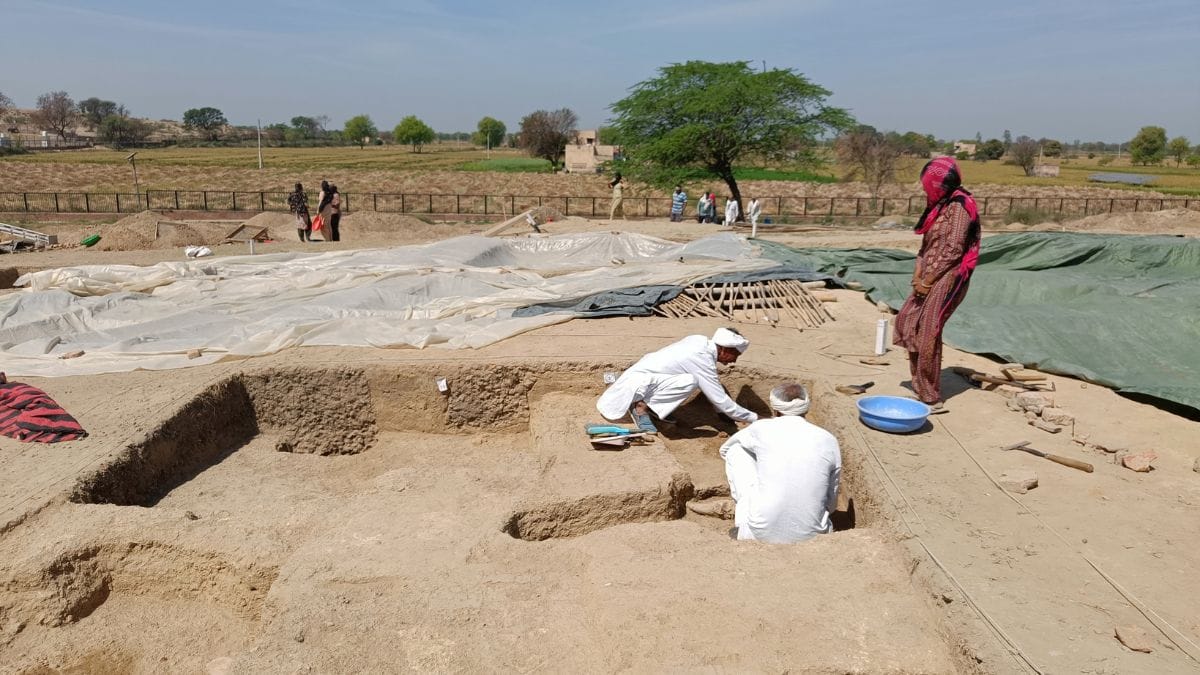
Understanding the Harappan Civilisation: Beyond River Rivalries
The focus of our inquiry shouldn't be whether the Indus or the Saraswati River hosted the largest cities, but rather the broader processes that contributed to the emergence of one of history’s most significant civilisations. To navigate this complex landscape, we must first clarify what archaeologists define as a city. Furthermore, the contemporary geographical distinctions that separate these ancient urban centres are recent constructs, often irrelevant to the historical context of the Harappan landscape.
Walter A. Fairservis defines a city as a culmination of various interdependent activities that come together under effective administration. This model suggests that cities do not arise in isolation; they evolve from pre-existing social and economic frameworks, which in turn shape their surrounding environments. The Harappan cities exemplify this principle, having developed from earlier regional traditions and intricate networks of trade, production, and social organization.
Urban centres like Rakhigarhi, Dholavira, Harappa, and Mohenjo-Daro are distinguished by features often associated with urbanism, such as standardized brick sizes, organized craft production, and advanced drainage systems. As Jonathan Mark Kenoyer notes, Harappan urbanism is deeply rooted in indigenous traditions while simultaneously engaging with adjacent cultures. The cities along the Indus and Saraswati were not the result of a single river or community, but rather the product of expansive social, economic, and cultural dynamics.
The Evolution of Harappan Urbanism
Prior to 3300 BCE, early food-producing settlements displayed regional characteristics, but by the mid-fourth millennium BCE, shared traits began to emerge. This Early Harappan phase laid the groundwork for urbanism that would flourish by the third millennium BCE. Notably, between 2800 and 2600 BCE, common cultural elements became more pronounced, with universally found artifacts like bull and human figurines reinforcing a shared heritage.
Many discussions around Harappan culture tend to focus solely on the urban phase, which lasted around 800 years. Just as contemporary cities like Delhi have absorbed older settlements and transformed due to economic and demographic changes, ancient cities evolved through extensive networks of villages and trade routes. Over 5,000 years ago, cities such as Mohenjo-Daro and Harappa developed alongside these networks rather than in isolation, leading to significant architectural and social advancements.
Geography and the Rise of Cities
Not all settlements transitioned into cities; many retained their roles as villages or industrial hubs. The geography of the Harappan civilisation played a crucial role in determining which settlements flourished into urban centres. The five major cities—Rakhigarhi, Dholavira, Harappa, Mohenjo-Daro, and Ganweriwala—are strategically positioned across different regions, reflecting the civilisation's expansive nature.
Recent excavations at Rakhigarhi reveal that even in its pre-urban phase, it was a significant settlement. As researchers continue to uncover its layers, they find that this city, much like Mohenjo-Daro, likely served as a vital link within the broader Harappan network, connecting various regions. With estimates suggesting Rakhigarhi spans over 500 hectares, further exploration may yield insights into the interconnectedness of these ancient urban landscapes.
Reframing the Debate on Harappan Cities
Instead of fixating on which city held the title of the largest, we should concentrate on how urban centres emerged across a vast and interconnected region. The definition of a city goes beyond mere size; it encompasses its administrative roles, production capabilities, and relationships with surrounding settlements. Cities are the results of complex processes, not mere geographic coordinates.
The debate around the Harappan cities should not be confined to modern political boundaries. It is essential to acknowledge and protect these archaeological sites, as many face destruction due to urban development. The loss of sites like RGR 6, which has been leveled for new constructions, threatens to erase our shared heritage. Advocating for the preservation of these historical sites is crucial for understanding our past and ensuring that future generations can appreciate the richness of the Harappan civilization.
Disha Ahluwalia, an archaeologist and junior research fellow at the Indian Council of Historical Research, emphasizes the importance of this perspective. Her insights remind us that the ancient legacy of the Harappan civilization transcends contemporary national narratives.
Comments